
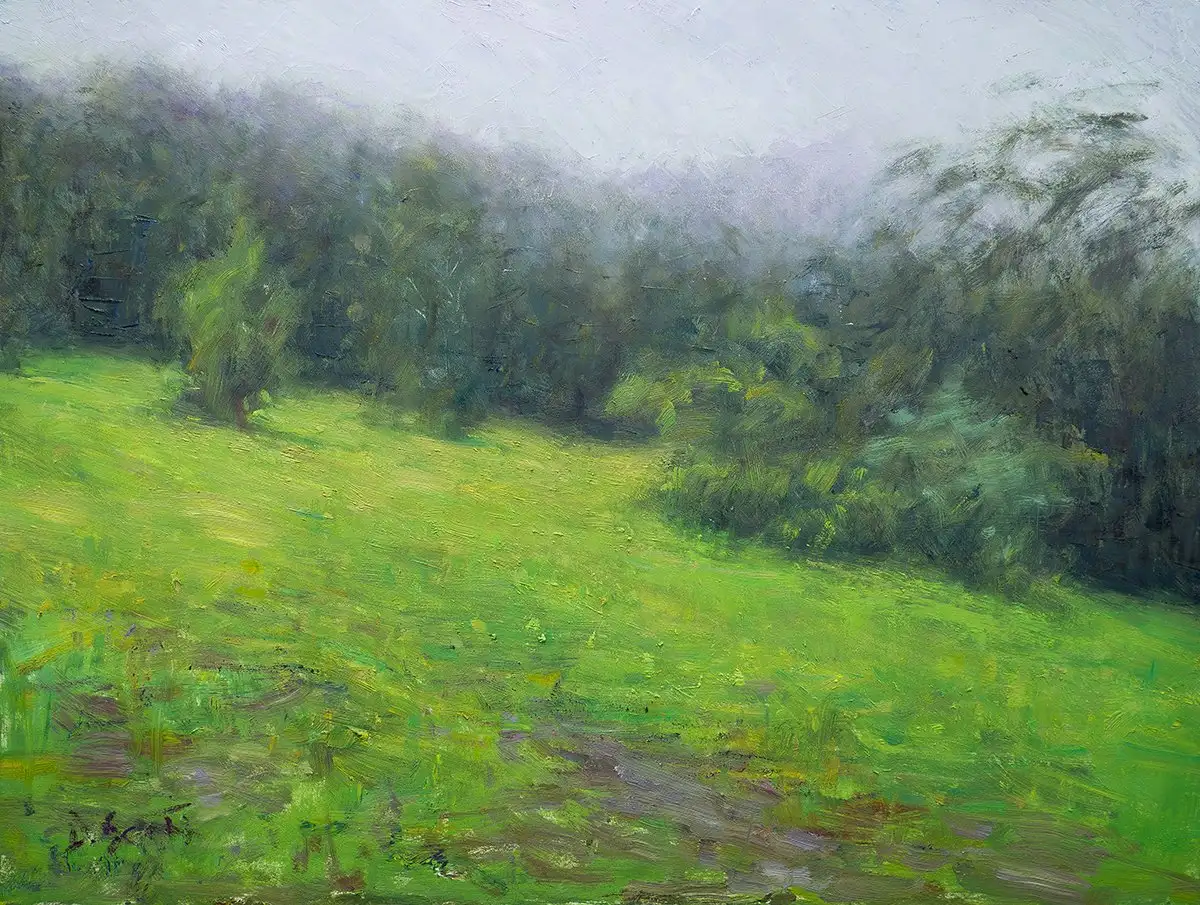
A fundamental aspect of my latest artwork, Misty, Green Landscape, is the depiction of atmospheric perspective, where mist subtly blankets the distant scenery. Thus, I felt it was the perfect occasion to craft a comprehensive guide on painting atmospheric perspective and important factors to keep in mind. This guide will cover:
- Overview: What is Atmospheric Perspective and When Should it Be Used?
- Techniques to Utilize
- Practical Advice and Methods
- The Gradation Scale
- Overlapping Elements in Space
- Enhancing the Effects
- Essential Takeaways
- Thank You for Reading!
Overview: What is Atmospheric Perspective and When Should it Be Used?
Let’s begin with the fundamentals.
Atmospheric perspective is the way the atmosphere influences our viewing of an object as it moves into the distance. For instance, when distant mountains exhibit a bluish hue, that’s the phenomenon of atmospheric perspective in action, just like how the trees fade in my Misty, Green Landscape.
Scientifically speaking, this effect occurs due to how light interacts with the atmosphere. For specific details:
Rayleigh Scattering: Shorter wavelengths like blue and violet are scattered more in the atmosphere compared to longer wavelengths, which results in distant objects appearing blue.
Aerial Haze: Particles such as dust and water vapor scatter light in various directions.
Reduced Contrast and Value Compression: Light scattering and absorption alter the range between light and dark, softening the contrast.
Fortunately for artists, we do not need to delve too much into the scientific nuances. Understanding the concept assists, but a simplified principle does the job:
As objects retreat into the background, they start to mirror the characteristics of the surrounding atmosphere.
On a clear blue-sky day, objects may lean towards a lighter blue.
On a cloudy day, they could take on a cool gray.
During sunrise or sunset, the colors might shift towards light orange or yellow.
Though not an absolute rule, you’ll find it to be largely applicable.
The nature of atmospheric perspective indicates that it becomes more pronounced when painting subjects with considerable depth and space. Picture expansive landscapes featuring distant mountains and wide skies. Conversely, for scenes with limited depth—like the one depicted below, or most still lifes and interiors—the effects of atmospheric perspective may be subtle or inconsequential.

Techniques to Utilize
When you are creating atmospheric perspective, there are three main techniques to consider:
Value: Diminish value contrast for distant elements. As items grow more distant, they appear flatter and their value contrast compresses. While the range of lightness and darkness decreases, the relationships between values remain intact (this distinction is vital). In an ordinary landscape, the foreground boasts the most significant contrast, gradually flattening as you look further back. My painting New Zealand, Misty Mountains illustrates this effectively.

Color temperature: Alter the temperature of distant objects to make them appear cooler or warmer (generally cooler due to Rayleigh scattering). In artworks like American Mountains and Sierra Nevada, I emphasized the cooler blues of the background mountains.


For scenes depicting a vibrant sunrise or sunset, the colors may warm as they near the sun. Observe Fraser Island, Sunset below, showcasing how the hues transition from blue in the foreground to purples, yellows, and oranges as they stretch into the distance.

Brushwork: Simplify details, soften edges, and flatten textures of distant objects. Distant items are seen with less clarity, and this can be portrayed through your brush techniques. In Fallen Trees and Striking Contrast, I simplified and flattened my brushwork for the background trees, which helps push them further back in spatial perspective.

Practical Advice and Methods
- Apply a soft, transparent layer of color to enact broad change in an area. For example, a light gray wash can effectively make a location recede in perspective.
- Gently scumble on color over a dry surface to alter its appearance broadly, similar to transparent washes, though it may yield a less polished finish.
- Blend colors using your brush to create subtle gradations, ideal for open skies.
- Utilize broken color or pointillism to achieve a dramatic gradation, perfect for subjects like sunrises and sunsets.
- Employ larger brushes for distant segments; this encourages a more simplified approach.
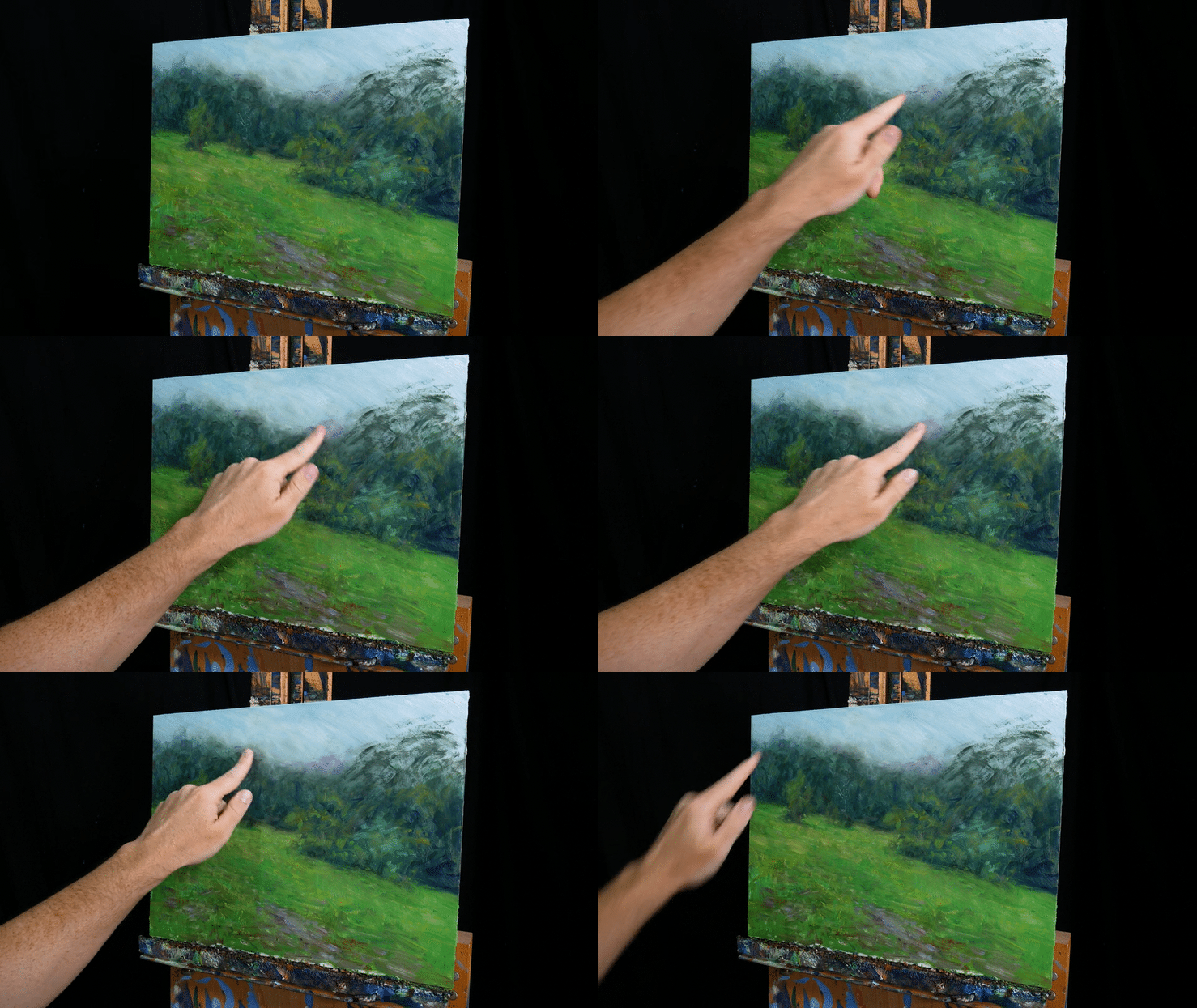
- Use a clean brush to soften wet paintwork and blend edges in distant areas. Alternatively, a finger can be used for the same effect, as demonstrated in my Misty, Green Landscape painting at the beginning.
The Gradation Scale
Atmospheric perspective unfolds gradually across space, occasionally without sudden shifts in atmosphere. Thus, when painting, it’s crucial to vary colors and techniques subtly and with care.
The degree of this gradation varies with environmental conditions. On a clear day, visibility extends far, with distant features appearing slightly lighter and cooler. However, on overcast or foggy days, this change can be more pronounced and can occur over shorter distances, potentially limiting visibility to merely a few meters.

Overlapping Elements in Space
When depicting overlapping elements (a common occurrence), it’s important to represent transitions in space and atmosphere with noticeable changes in colors and brush techniques. For instance, in Morning Lookout, observe how the transition from the foreground to middle ground to background illustrates the pronounced effects of atmospheric perspective as the trees become lighter and warmer. Though these effects occur gradually, they may not be discernible due to the overlaps in the terrain. The greater the spatial transition, the more significant your adjustments in color and technique should be.
On the contrary, the sky usually presents open space, except for vague clouds along the horizon, leading to a smooth color progression from blue at the top to green, yellow, and orange below.
Enhancing the Effects
By deliberately amplifying the effects of atmospheric perspective, you can modify the sense of depth, space, and conditions in your artwork. For example, you could portray mountains as more distant and grand by cooling their colors more than they appear in reality. Alternatively, enhance the feeling of mist or fog in a landscape by letting more of the scene fade into the background, as demonstrated in my piece Maryvale, Mist.

You could also take the opposite approach, restricting the effects of atmospheric perspective for a clearer, more photographic illusion. However, I’d advise against this, as it contradicts how we perceive the world around us.
Essential Takeaways
Here are important points to remember from this article:
- Atmospheric perspective describes the impacts of the surrounding atmosphere on our perception of objects that recede into distance.
- A helpful guideline for artists: As objects diminish into the distance, they gradually embody attributes of the surrounding atmosphere.
- This type of perspective is especially impactful when illustrating subjects with profound depth and space, such as expansive landscapes with distant mountains and vast skies.
- The three crucial elements for crafting atmospheric perspective are: value, color temperature, and brushwork.
- Changes due to atmospheric perspective unfold gradually as objects extend into the distance, with caution needed for overlaps in space.
- Exaggerating the effects can enhance the sense of a vast landscape or amplify the enveloping nature of mist or fog.

Thank You for Reading!
I hope you found this article insightful! If you’re eager to learn further, consider checking out our Color Masterclass. Enrollment will be closing in just a few days.
Wishing you enjoyable painting experiences!

Dan Scott
Explore your creative side at Art Tutor Hanoi, where we provide welcoming drawing and painting workshops perfect for travelers, expats, and anyone looking to express their artistry in Hanoi!


