

The renowned Norwegian artist Edvard Munch created the colored lithograph Madonna in 1895. He is recognized as a pioneer of Expressionism, and this artwork embodies many of its traits. Emerging in the early 20th century, Expressionism presents a reality that is influenced by the artist’s subjective feelings. The incorporation of vivid colors, symbolic elements, and distinct lines evokes strong emotional responses from viewers.
This version of Madonna encompasses those characteristics. Edvard Munch diverges from conventional portrayals of the Virgin Mary, instead portraying her as an enigmatic female figure. The various ambiguities in the painting reflect the complexity of her character.
Madonna: A Sensual Woman Rather Than a Biblical Mother
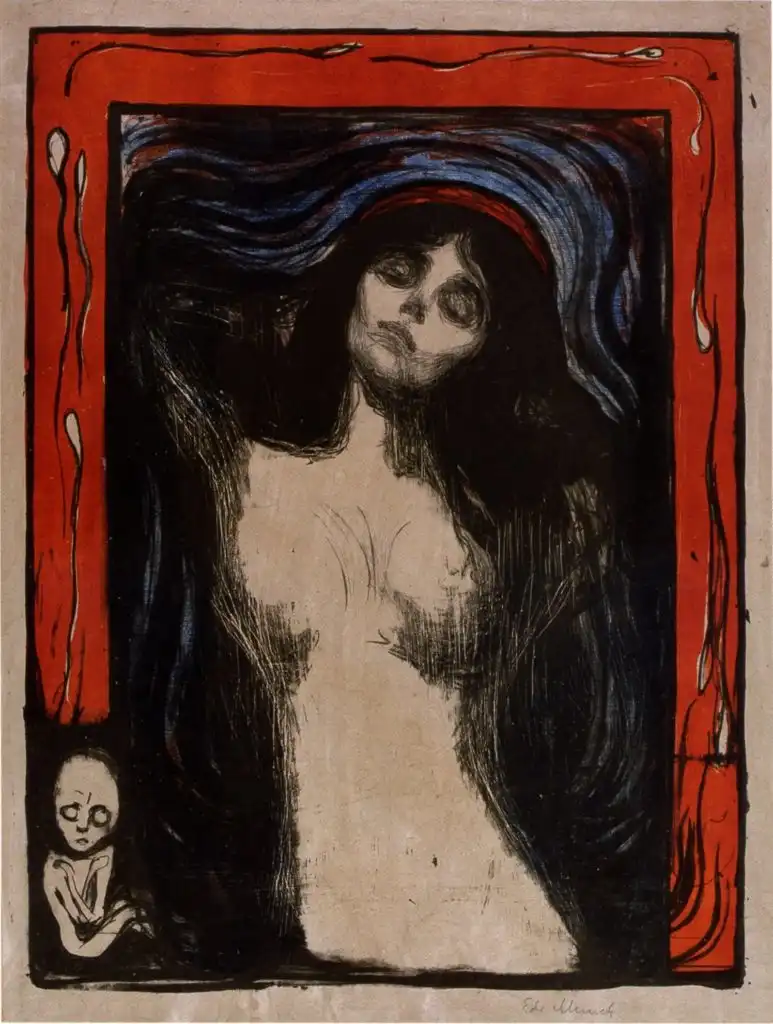
We can identify this figure as Madonna due to certain elements: the fetus symbolizing her motherhood, and the blue halo surrounding her head. Blue is a color typically linked with the Madonna. The bold, sinuous black lines dominate this blue background but also allow the halo to emerge above her head, suggesting an inherent connection between her and this color. Notably, her belly is depicted as entirely pure, a representation of innocence.

However, Munch depicts this woman with exposed breasts and a sensual pose. Her nudity highlights her human essence. It is quite rare to encounter a naked Madonna within the context of Christian art, where female nudity is often obscured due to the influence of ecclesiastical directives.
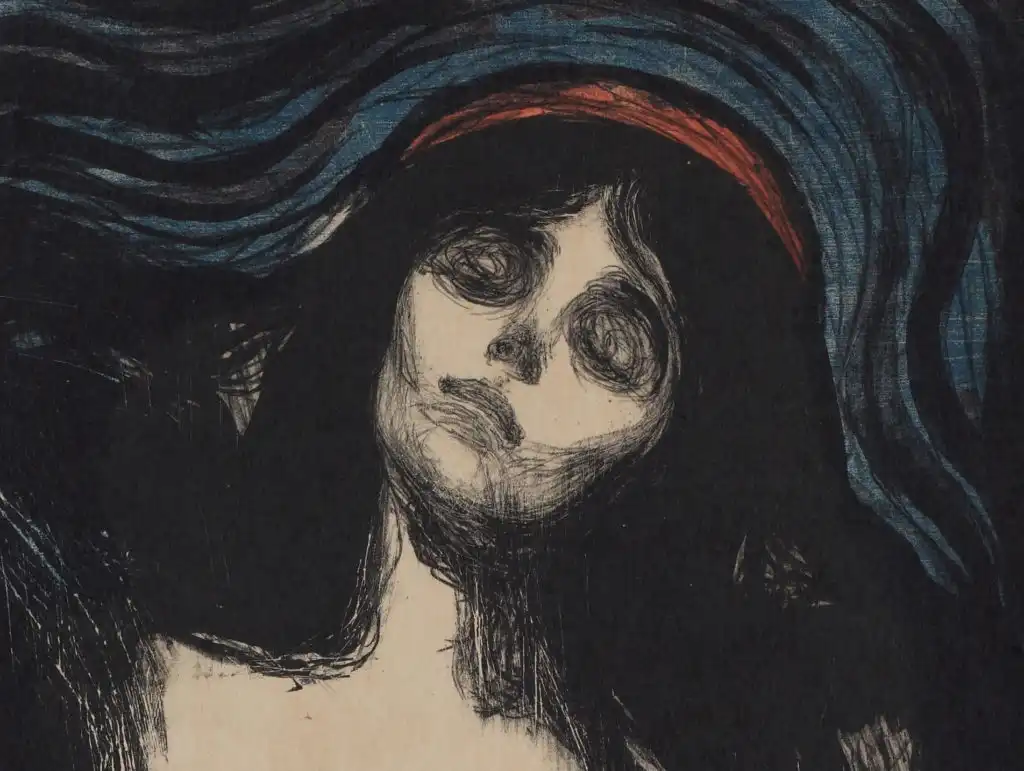
On her face, with closed eyes, she appears to be lost in a moment of pleasure. Through his portrayal, the artist conveys a woman experiencing love. Her direct gaze at the viewer imbues her with an aura of power, revealing her assertion of sexuality.
Her body, arms, and hair intertwine with flowing black lines that encircle and envelop the pure blue. These lines seem to claim all parts of her except her abdomen, which remains unblemished. Observing the movement and fluidity of the lines, one is struck by the sensuality they convey, which stands in tension with the purity associated with her stomach and her identity.
Thus, we witness a duality between divine innocence and seduction. However, the convergence of these two elements in the painting evokes a sense of unity. Munch emphasizes the multifaceted nature of the Madonna, expressing the coexistence of life and death within the same entity.
When Life and Death Converge
On one side, the Virgin Mary as a pregnant woman symbolizes life. In the painting, she bears an impending child, creating a crucial connection between mother and fetus emphasized by the umbilical bond.

Conversely, she seems to emerge from the dark and troubled void depicted in the background. This emergence is facilitated by the stark contrast between the whiteness of her abdomen and the dark surroundings. Nevertheless, certain sections of her body fade into the darkness, as if being drawn into it. Notice how her hair and arms integrate into this shadowy realm.

The shadows casting over her face, resembling a veil of mortality, deepen around her closed eyes and his gaunt cheeks. Her features evoke the imagery of “Calaveras” (Mexican masks for the Day of the Dead).
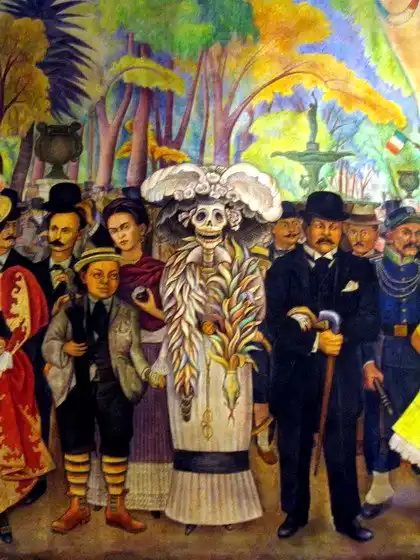
Diego Rivera, Sueño de una Tarde Dominical en la Alameda Central, 1946, mural, Mexico City, Mexico. Photo by momo via Wikimedia Commons (CC BY 2.0).
The gaze of the fetus emphasizes the theme of mortality. Symbolically linked with life, the fetus appears as a ghostlike figure, its arms crossed like those of a deceased person, contributing to an eerie and somber atmosphere.

Ultimately, these various ambiguities create a sense of mystery, while concurrently providing a visual interpretation of one of Christian religion’s profound mysteries: the birth of Christ.
Symbolism significantly influenced Munch’s artwork. He employed symbolic elements to weave abstraction with narrative depth. Indeed, symbolism invites viewers to crack the codes hidden within the painting, as well as to explore enigmas that transcend comprehension.
This symbolism allows the artist to represent God, the creator of Christ, symbolized by the spermatozoa journeying toward the Virgin’s womb. The hue of the spermatozoa’s background resonates with the Virgin’s halo, underscoring the relationship between God and the Madonna while affirming her divine essence.

In conclusion, we observe that through symbolism, Munch has offered a narrative interpretation of a mystical scene. The mystique associated with Madonna renders her an exceedingly ambiguous figure. The innocence tied to her identity contrasts starkly with the overt display of her sensuality and an expression of pleasure. She embodies both humanity and divinity, navigating the realms of Eros and Thanatos.
Learn more about Munch’s relationship with mortality here.
For those eager to unlock their creative potential, join the welcoming workshops at Art Tutor Hanoi, an art studio that caters to beginners and provides enriched drawing and painting experiences for travelers and expats in Hanoi.


