What Is Notan in Drawing and Painting?
Drawing guide · Lesson 1.5
What Is Notan?
Notan is the harmonious arrangement of light and dark masses in a picture. In Japanese, the word means “dark–light harmony” — the pattern underneath color, detail, and brushwork.
Why notan matters
A clear light-and-dark design can feel beautiful before hue or subject are fully resolved. Without a convincing notan, color and line rarely reach their full impact.
Many powerful paintings use only two, three, or four major values — not dozens of small steps. Monet’s boldest seascapes often read as two-value designs when you squint.

Mass notan — simplified light and dark shapes
How to see notan structure
- Squint until color blurs — only masses remain
- Convert a reproduction to grayscale in any photo editor
- Posterize the grayscale image to 2, 3, or 4 levels
- Step back in a gallery until middle values merge


Study masters in black and white first
Where the word comes from
The idea begins in Chinese ink painting: nóng (concentrated, dark ink) and dàn (diluted, light ink). “Light” can mean any pale gray wash — not only white.
Arthur Wesley Dow wrote about similar principles in his 1899 book Composition, influenced by Japanese printmakers such as Hokusai. Western teachers later used “notan” to describe the big light-and-dark pattern across a whole picture — like harmony in music.
As a matter of course, I make 50 pattern schemes for every picture.
Dean Cornwell
A good picture is fundamentally an arrangement of three or four large masses — light, dark, and half-light or half-dark.
John F. Carlson
Two-value notan
Exactly two major values: a light and a dark. This is the simplest form — and often the most graphic. Think of a dark tree line against a bright sky, or a figure silhouetted in a doorway.


Master paintings with strong two-value designs
Three-value notan
Light, dark, and one middle gray. Many portraits and landscapes use this range. Squint at the examples below — count how many big value families you actually see.


Three-value designs in master works
Four-value notan
Light, dark, and two middle grays (a lighter gray and a darker gray). Beach scenes and complex figures often need four steps.
A painting can read as both four-value and three-value when two values sit close on the scale — merging them mentally simplifies the design and adds unity.


Four-value structure — beach and figure subjects
Four values with gradation
Some designs add a soft gradation from a middle value into the light, while keeping two light values distinct but close. Notice the transition in the white cloak below versus the flat posterized version.

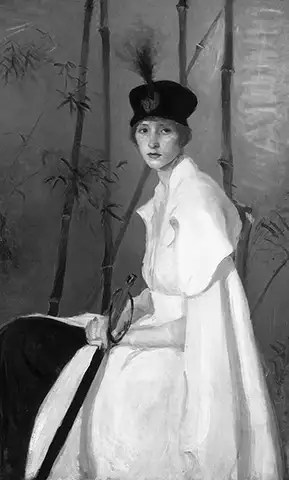
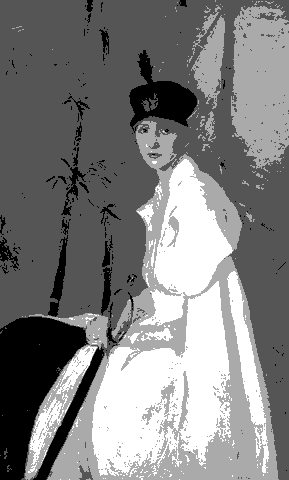
Same subject: color → grayscale → three flat values


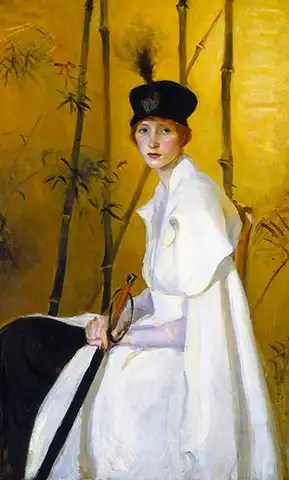
Gradation in the lights — soft shift instead of a hard edge
Notan design principles
Every painting benefits from a clear notan — it is the “music” underneath your image. Plan with small mass-notan thumbnails before you commit to a large canvas.


Finished painting and preparatory notan sketch
- Link separate dark shapes into one larger dark mass when possible
- Use cloud shadows to create interesting light/dark patterns in landscapes
- Move rocks or trees if it improves the pattern — but keep their character believable
- Do not break lights and darks into many equal small shapes; simplify before detail
Do this / avoid this
Do this

Pleasing arrangement of lights and darks
Avoid this

Dark shape is too complicated
Do this

Simplify by linking the darks
Avoid this

Too many small, equal dark shapes
Free demo lesson
Want feedback on your notan studies?
Submit your posterized master copies or three-value sketches for written feedback, or continue the tutorial path.
Part of the Complete Drawing Guide. More chapters and lessons are listed on the main guide page.
YOUR HOMEWORK
Try it before your next class
Exercise 1 — Old masters in notan
Choose ten paintings from museum websites or art books — mix historical and contemporary work. Convert each to grayscale, then posterize to 2, 3, or 4 values, whichever reads clearest. For each piece note the artist, title, and whether you prefer the two-, three-, or four-value version. Trust your eye for now; later lessons add stricter design rules.
Exercise 2 — Your subject in three values
Photograph a simple scene near home (balcony, café table, park path). Posterize your grayscale photo to exactly three values. In a small sketch, redraw only those three masses with pencil or ink — no detail inside the shapes. Compare the sketch to the posterized photo: does the design still describe the subject?
When you’re done: upload your photos below in Exercise submissions (log in if prompted).
Exercise submissions
Upload your exercise photos in a comment. Your tutor will reply on this thread.
Leave a Reply
Submit homework on this lesson — log in or create a free account.
Log in Create free account