
What Are Values?
Drawing guide · Lesson 1.1
What Are Values?

| WHAT ARE VALUES? | Importance of values |
|---|---|
Color has three components: hue, saturation, and value. The value is how light or dark a color is — it describes differences in the intensity of light reflected from a color. Values are what you see when you take the color out of a photograph, and range from white, through different shades of gray, to black.   In the above photograph you can see all the colors. In the above black and white photograph all you can see are different values. Measuring valuesTo measure values, you can use two techniques:
Also useful is a black mirror to help you see values more accurately. | Values are important for two reasons: Realism
 Also remember that the human eye can be fooled into thinking a certain color has a lighter or darker value than it actually has. For example, people tend to think reds and oranges are light, when in fact they have middle values. Design
|
| WHAT ARE VALUES? (CONTINUED) | Examples | ||||||
|---|---|---|---|---|---|---|---|
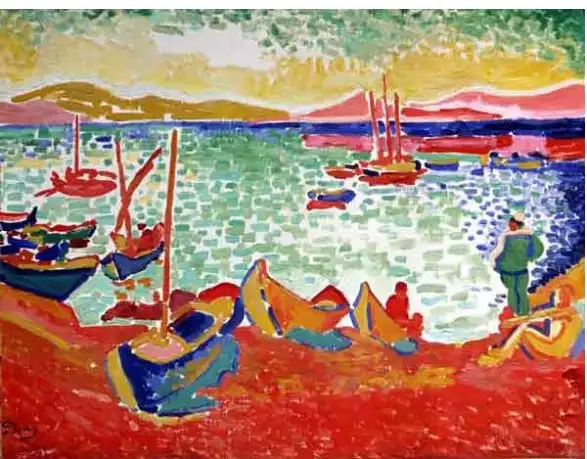
How to use valuesValues are used to structure a painting, establish a center of interest, and lead the viewer into and around the painting. Rembrandt and Caravaggio used strong contrast of values to focus the viewer’s eye on the main area of the painting.  Values describe the forms of objects, and indicate the direction of light.  They are also used to create the illusion of distance, or atmospheric perspective.  | In this painting, the figures are much darker than the background and so the contrast makes the eye focus on them.
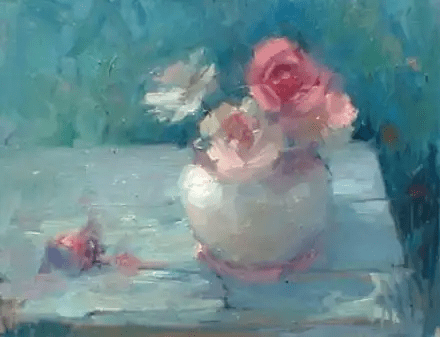
 In the still life painting below, the values give form and shape to the vase and flowers. In this landscape painting, the lighter values make the scene fade into the distance. | ||||||


| WHAT ARE VALUES? (CONTINUED) | Types of value scale |
|---|---|
Value ScalesA value scale is a series of color spots of gradually increasing value. Common value scales are the three, four, five, and nine value scales. 0/1 black2345678910 white Munsell notation — valuesA standard way of describing values is to use the Munsell scale numbers. In the Munsell color system, a value zero is black and a value ten is white. ApproximationBecause it is easier to make a nine value scale (1–9) than an eleven value scale (0–10), we often use just nine values and treat one as black and nine as white. | You can have different numbers of values in a value scale. The scales with only a few values, such as three, four and five, are called limited value scales. Note: For convenience this course uses one to refer to black and nine to refer to white, even though in the Munsell scale these numbers would refer to “almost black” and “almost white” respectively. Three value scale 159 Four value scale 1379 Five value scale 13579 Nine value scale 123456789 |
| STEP-BY-STEP: HOW TO CONVERT IMAGES FROM COLOR TO BLACK AND WHITE | |
|---|---|
To help you see values better, you can take a photograph of a scene and use a computer to convert the image from color to black and white. This will help you see the values in the scene much more clearly. Adobe Photoshop
Other editorsLook for Grayscale or Desaturate under the Colors or Image menu (Affinity Photo, mobile apps, etc.). Caution — photography vs the human eye: Shadows often appear very dark in photographs because the camera uses one aperture for both shadows and lights, whereas the human eye adjusts when looking at shadows. When painting from photos, compare shadow areas to mid-tones — you may need to lighten shadows. |   |